
Institutional Objective
To serve as the national intellectual locomotive in the transition towards a decentralized future economy, guaranteeing national data sovereignty, and strengthening financial inclusivity through technological innovation.
Operating at the intersection of rigorous academic inquiry and practical industry application, DECODE provides actionable data, policy recommendations, and scholarly communication aimed at transforming traditional ecosystems into advanced, tokenized, and ethically governed models.
Output Targets
Core Research Pillars
The foundational domains guiding our methodology.
Data Science
Developing predictive algorithms, large language model integrations, and bibliometric analyses to map technological adoption trends.
Digital Business
Studying tokenomics, Web3 marketplace dynamics, and strategic governance frameworks for decentralized autonomous organizations (DAOs).
Development Econ
Assessing macroeconomic impacts of CBDCs (Digital Rupiah) and regulatory strategies for protecting gig workers in the digital transition.
Strategic Roadmap
Technology Readiness Level (TRL) Progression
Policy & Ethics
TRL 3: ConceptFlagship Research
AI Ethics in Islamic Business & Gig Worker Protection.
- • Academic Drafts
- • Regulatory Policy Briefs
Smart Gov
TRL 4: ValidationFlagship Research
Gov-Tech for Tier II Regional Bureaucracy Efficiency.
- • Digital Gov Models
- • System Prototypes
Virtual Econ
TRL 5: ExperimentFlagship Research
Digital Asset Ownership Rights in the Metaverse.
- • Virtual Tx Regulations
- • Digital Asset Frameworks
DeFi Systems
TRL 6: PrototypeFlagship Research
Tokenomics Design & Cooperative Modernization via DAO.
- • Zakat/ZIS Smart Contracts
- • DAO Architecture
Sustainability
TRL 7: CommercialFlagship Research
Sustainable Digipreneurship & Independent Ecosystem Incubation.
- • Web3 Business Platforms
- • Large-Scale Implementation
Recent Research
View All →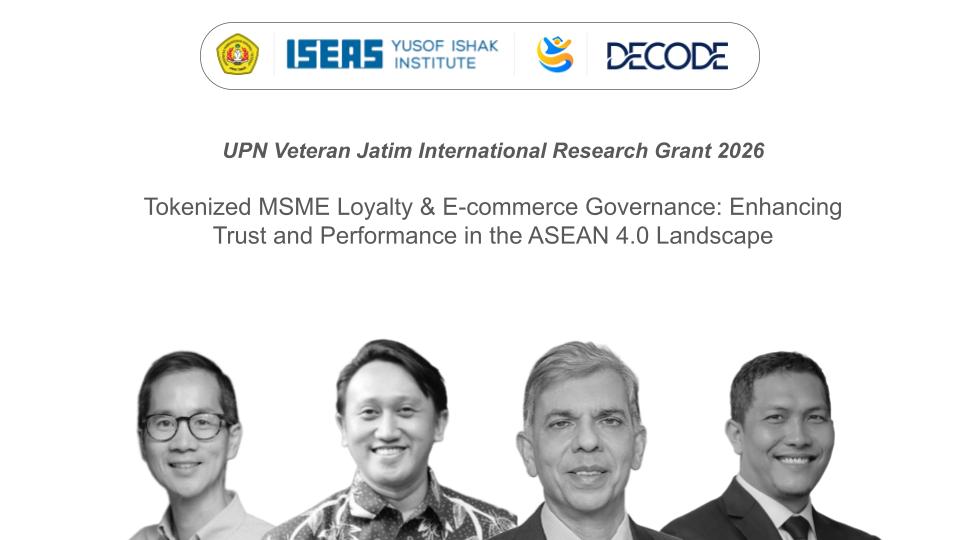
Tokenized MSME Loyalty & E-commerce Governance: Enhancing Trust and Performance in the ASEAN 4.0 Landscape
The marketplace-based platform economy serves as a primary driver of growth for Micro, Small, and Medium Enterprises (MSMEs) in ASEAN, yet customer trust and cross-border regulatory fragmentation remain significant barriers to sustainability. While blockchain-based tokenized loyalty programs offer a transparent solution to enhance customer retention, they simultaneously introduce novel governance risks concerning data protection. Addressing this urgency, this cross-country comparative research evaluates the adoption of such technologies to formulate inclusive e-commerce governance standards that support the ASEAN 4.0 transformation. Specifically, the study seeks to evaluate the impact of tokenized loyalty designs on MSME trust and adoption in Indonesia and Malaysia, map consumer protection risks stemming from the digital divide and dispute resolution, and propose a draft of an e-commerce governance framework that balances cryptoeconomic innovation with regional legal compliance. The study employs a sequential explanatory mixed-methods design. The quantitative phase involves a survey of 500 marketplace MSMEs and 800 consumers across East Java (Indonesia) and Selangor/Kuala Lumpur (Malaysia), with data analyzed using Partial Least Squares Structural Equation Modeling (PLS-SEM) adapted from the UTAUT2 model. Subsequently, the qualitative phase utilizes thematic coding analysis on in-depth interviews with key stakeholders, including platforms, regional regulators, and ISEAS partners. The targeted outcomes of this research encompass a publication in a reputable Scopus-indexed international journal, an International Agreement between UPN "Veteran" East Java and the ISEAS – Yusof Ishak Institute Singapore, a presentation at the International Seminar Research Month, and a regional Policy Brief outlining minimum governance standards for tokenized loyalty.
Read Full Report
Digital Doppelgängers to model human behavior and cognition.
The global digital twin market is expanding rapidly, projected to grow from roughly $24.5 billion in 2025 to over $259 billion by 2032. Future advancements are expected to integrate Generative AI for more autonomous decision-making and Digital Doppelgängers to model human behavior and cognition.
Read Full ReportExpert Insights
Read More →
Consumer Behavior Analysis
It is the study of individuals, groups, or organizations and the processes they use to select, secure, use, and dispose of products or services to satisfy needs. Understanding these patterns allows businesses to design better products and marketing strategies.
Read Analysis
The Schelling Point of Science: A Game-Theoretic Analysis of Token-Curated Registries in Scholarly Communication
Traditional academic publishing is experiencing an incentive failure. The value created by researchers is captured by centralized publishers, leading to the serials crisis and a lack of scalable validation. This insight analyzes the mechanism design of a decentralized alternative: applying Token-Curated Registries (TCRs) to scholarly communication. We utilize game theory to demonstrate how properly aligned cryptoeconomic incentives can facilitate a high-quality academic Schelling Point, improving both validation speed and rigor.
Read Analysis